
Curriculum-Based Professional Learning (CBPL) is a high-quality professional development method that can significantly improve student outcomes. It ensures that teachers fully understand the state-approved high-quality instructional materials they use in the classroom and are prepared to deliver instruction that meets the Mississippi College- and Career-Readiness Standards (MS CCRS). CBPL is closely linked to increased student achievement, as it equips teachers with essential skills, knowledge, and strategies for effective instruction, thereby improving learning outcomes. When teachers engage in relevant, evidence-based, and ongoing professional development that concentrates on student needs, they become better equipped to foster student success.

State-Approved CBPL Providers
State-Approved Curriculum-Based Professional Learning (CBPL) Consultants are individual providers who have successfully completed the Mississippi Department of Education (MDE) CBPL Micro-Credentialing Program and are approved to deliver professional learning aligned to High-Quality Instructional Materials (HQIM). Approval indicates that the consultant has met MDE requirements for quality, alignment, and implementation support.
Click on each consultant’s company name to view contact information, educator services, approved content areas, and HQIM expertise.
- Bailey Education Group
- Excellence Group
- Great Minds Curriculum
- Greene Education Services
- Kids First Education
- Kirkland Group
- SAVVAS Curriculum
CBPL Types
- Launch occurs when new materials are adopted or a teacher or leader is new to a district or grade level. It helps educators understand how the materials are designed and intended for use.
Timeline: Prior to Implementation | Delivery Model: Consultations and Workshops
Objectives: Articulate and communicate a vision for exceptional instruction, emphasizing the role of HQIM in achieving this vision. It assists educators in understanding HQIM’s approach and design and how they align with the instructional vision. Navigates specific logistical and technological considerations for publishers, including organizing materials and ensuring accessibility for teachers and students. - Implementation occurs when stakeholders understand how the HQIM aligns with the academic vision and ensure that students master grade-level content by the end of the year. They are more likely to invest in their long-term success. Engage stakeholders early and often to ensure they understand the curriculum’s approach and design, and act as ambassadors for the materials in their schools. Most importantly, teachers should have ample time to receive meaningful initial training on the adopted curriculum.
Timeline: Years 1 and 2 | Delivery Model: Collaborative Planning Time, Coaching, and Workshops
Objectives: Create a clear vision for the effective implementation of the HQIM, aligned with the instructional vision. It helps teachers internalize initial units and lessons by facilitating rehearsals with peers who teach the same content and HQIM. - Ongoing PL for Teachers is the regular support that helps all educators, especially those new to the profession, implement HQIM effectively. This professional learning may take the form of collaborative learning or coaching. It includes teachers’ understanding of when to use the curricula with fidelity and integrity.
Timeline: Years 2+ | Delivery Model: Collaborative Planning Time, Coaching, and Workshops
Objectives: Reinforce the effective implementation of the HQIM in alignment with our instructional vision. It supports teachers in collaborating on lesson preparation, anticipating student responses, and adapting the model to meet all students’ needs while providing rigorous, grade-level instruction. It aids in analyzing student data and HQIM work. - System Design and Leader Support generally offers more customized training to help local education agencies (LEAs) create the necessary conditions and training to support teachers and foster sustainability within the school.
Timeline: Year 1+ | Delivery Model: Collaborative Planning Time, Coaching, and Workshops
Objectives: Convey a vision for effective HQIM implementation that aligns with instructional goals. Assists leaders in allocating the necessary time and resources for successful HQIM execution. Helps leaders track and recognize trends in student learning and teaching practices.
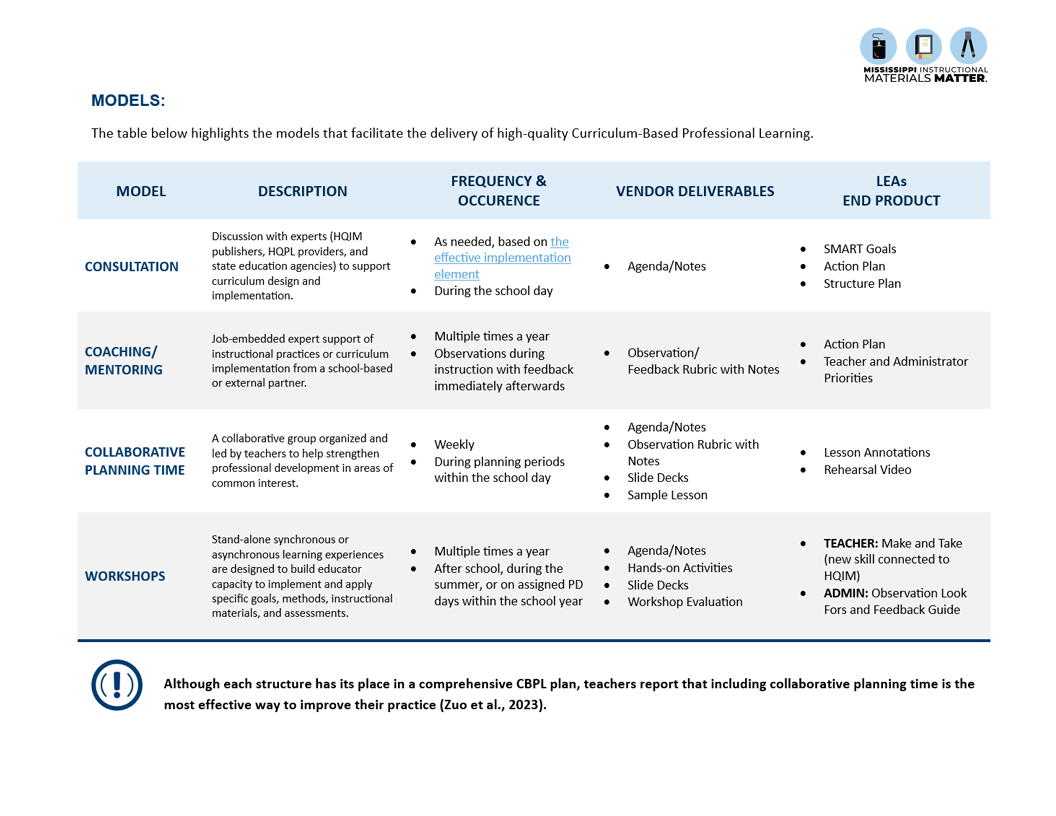
CBPL Models
It should include the following features: 1) high-quality instructional materials at the center; 2) development of teachers’ content knowledge and pedagogical content knowledge within the context of HQIM; 3) grounding in evidence of student learning with an emphasis on evidence-informed decision-making; 4) attention to teacher motivation and mindset; 5) differentiation of support for new and developing teachers; 6) occurrence on a regular and predictable basis; and 7) support from leadership.
- Consultation: Discussion with experts (HQIM publishers, HQPL providers, and state education agencies) to support curriculum design and implementation.
- Coaching/Mentoring: Job-embedded expert support of instructional practices or curriculum implementation from a school-based or external partner.
- Collaborative Planning Time: A collaborative group organized and led by teachers to help strengthen professional development in areas of common interest.
- Workshops: Stand-alone synchronous or asynchronous learning experiences are designed to build educator capacity to implement and apply specific goals, methods, instructional materials, and assessments.